
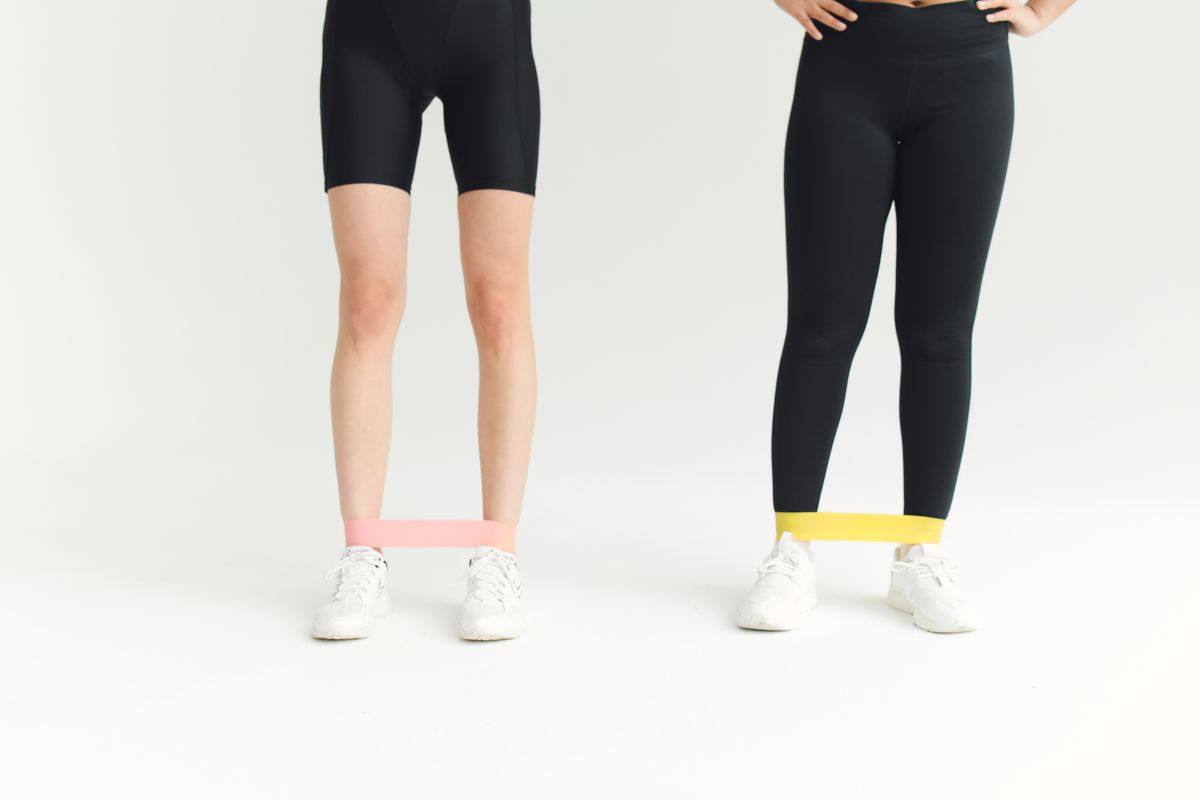
Fit Simplify Resistance Loop Bands (Set of 5)
A set of 5 color-coded loop bands, from light to extra-heavy resistance, that pack into a small carry bag — enough to build a full-body strength routine at home, in a hotel room, or outside, with no gym required.
- 5 resistance levels in one set, so you can scale exercises up as you get stronger
- Comes with a carry bag and instruction guide — easy to travel with and easy to start using right away
- Rated above 4 stars by more than 135,000 buyers — check the current figure on Amazon
As an Amazon Associate I earn from qualifying purchases.
The short version
For all five bands, a carry bag and a lifetime warranty at a budget price (check the current price on Amazon), this is the cheapest genuinely useful piece of strength equipment you can buy. The maker’s own estimate puts the set at roughly 2 lb to 30 lb of dumbbell-equivalent resistance (the Amazon listing gives no figures), it is latex, and Amazon shoppers rate it above 4 stars across more than 135,000 ratings — one of the largest review samples of any fitness product on the site.
What each band actually gives you
This is the fact buyers most often go looking for and most reviews leave out. The Amazon listing only calls the five bands “extra light” to “extra heavy”; the figures below are Fit Simplify’s own estimates from its buyer’s guide, which it describes as an inexact dumbbell comparison:
| Band | Maker’s estimate | What it is for |
|---|---|---|
| Extra light | 2–4 lb | Rehab, shoulder and rotator-cuff work, the first week of anything |
| Light | 4–6 lb | Warm-ups, glute activation before squats |
| Medium | 10–12 lb | The one most people end up using for lower-body sets |
| Heavy | 15–20 lb | Banded squats, hip thrusts, lateral walks once you are conditioned |
| Extra heavy | 25–30 lb | Strong legs, or assistance work for pull-ups |
Each band is 12″ long and 2″ wide unstretched. If you are buying one set for a household, the medium is the band that will wear out first.
The lifetime warranty nobody mentions
Durability reports on this listing are mixed — a minority of reviewers had a band snap, and that is the complaint most likely to put you off a budget purchase. What the reviews rarely mention is that the set carries a lifetime warranty. That does not make a band unbreakable, but it changes the calculation: a snapped band becomes a replacement request rather than a repurchase.
One thing to check before you buy: they are latex
The bands are made of latex. If you have a latex allergy this set is not for you, and that is worth knowing before rather than after — sensitivity shows up as skin irritation where the band sits. Fabric bands are the usual alternative and are latex-free, though they cost several times as much and offer a narrower range of resistance.
The rolling problem, and how to avoid it
Almost every complaint about loop bands is the same one: the band creeps and rolls up when it sits on bare thigh. Wearing leggings rather than shorts fixes it for most people, as does sitting the band just above the knee instead of mid-thigh. Fabric bands solve it permanently, at a price.
Who it suits — and who should skip it
Buy them if you want strength work in a hotel room, a small flat, or a rehab programme where the load has to start very low. They weigh almost nothing, fit in a coat pocket, and at this price the downside of it not working out is negligible.
Skip them if you mainly want upper-body pressing — there are no handles and no door anchor, so bands are awkward for that and a pair of dumbbells serves you better. Skip them too once you can do twenty comfortable reps against the extra-heavy band: at that point you need real weight, and no band set will keep up.
What buyers report most often
Across more than 135,000 Amazon ratings averaging above 4 stars, the recurring positives:
- The five levels genuinely cover beginner through to strong
- The carry bag makes them easy to travel with — the most common use case by far
- Widely used for physiotherapy and rehab, not only workouts
- Compact enough to leave in a drawer and actually use
And the recurring complaints, which matter more before you spend:
- Bands rolling up the thigh during squats and side-steps — the most common annoyance
- Durability is mixed; a minority report a band snapping
- Some sliding during exercises, especially against bare skin
Your resistance figures don’t match what Fit Simplify itself says. Which is right?
Fair challenge, and the honest answer is that nobody publishes a hard number for this set. The current Amazon listing describes the five bands only as “extra light” to “extra heavy” and gives no pounds per band. Fit Simplify’s own buyer’s guide estimates its loop bands at roughly 2–4 lb (extra light), 4–6 lb (light), 10–12 lb (medium), 15–20 lb (heavy) and 25–30 lb (extra heavy) “when equated to dumbbell weights” — and calls that comparison an inexact science.
So plan around the maker’s lower figures, not the bigger ones that circulate in reviews. Two things follow. First, a band does not load like a dumbbell: resistance is near zero at rest and only reaches its rating near full stretch, so the colour is a progression ladder, not a weight you can compare with the gym. Second, the whole set tops out around a 25–30 lb dumbbell at best — which is why this page says to move on once the extra heavy band feels easy. If you need a known load for a rehab programme, your physiotherapist’s band chart beats any retail estimate.
Can a band that peaks at 25–30 lb build real strength, or is this a warm-up toy?
Bad news first: if you already squat or press real weight, no. A loop band cannot replace that load, and no honest page will tell you otherwise.
For everyone else the evidence is better than the price suggests. A 2019 systematic review and meta-analysis (Lopes et al., SAGE Open Medicine, DOI) pooled eight trials comparing elastic resistance with weight machines and dumbbells and found no difference in strength gains for either the lower or the upper limb. Two caveats: those trials used tubes and Thera-Band-style bands rather than mini loops, and the band groups trained to a genuinely hard effort, not a token twenty reps.
That second point is the practical rule. A band only builds strength when the last two or three reps of a set are difficult. If the medium band stops doing that, use the heavy, then stack two. When twenty controlled reps against the extra heavy band feel easy, you have used the set up — and that is a good problem, because it means it worked.
Which band do I use for which exercise? The booklet doesn’t say.
Correct — it doesn’t. Fit Simplify’s online video guide lists the exercises it recommends (squats, side-walking lunges, bridge, side leg raises, lying leg raises, bicep curls, lat pull-downs, bent-over rows, lateral raises, chops, two-band squats and two-band crunches) but assigns no colour to any of them. The mapping below is ours, not the maker’s. It is generic, based on how large the muscle group is, so treat it as a starting point and adjust by the hard-last-reps rule above.
| Exercise | Start with | Why |
|---|---|---|
| Lateral raises, rotator-cuff work | Extra light | Small muscles; heavier bands wreck the form |
| Side-lying leg raises | Light | Long lever, little muscle behind it |
| Lateral band walks, side lunges | Medium | Glute medius tires fast; medium keeps the knees tracking |
| Bicep curls, bent-over rows | Medium | Standing on a 12″ loop limits the stretch, so it feels heavier than the colour suggests |
| Squats (band above knees) | Heavy | Big muscles; the band cues knees out rather than adding load |
| Glute bridge, hip thrust | Heavy or extra heavy | Strongest movement in the set; this is where the top bands earn their place |
Five of these fit a hotel room, which is the most common reason people buy this set — the routine is laid out in our hotel-room resistance band guide.
Common questions
Which band should a beginner start with?
The light band (about 4–6 lb by the maker’s estimate) for lower-body work, and the extra light (about 2–4 lb) for anything involving the shoulder. Starting too heavy is the fastest way to end up with poor form and an unused set.
How much resistance is in the whole set?
The Amazon listing gives no figure. Fit Simplify’s own guide estimates roughly 2–4, 4–6, 10–12, 15–20 and 25–30 lb dumbbell-equivalent, and calls the comparison inexact; a band only reaches that near full stretch. You can double up two bands for more, though the rolling problem gets worse when you do.
Do the bands snap?
A minority of reviewers report it. The set carries a lifetime warranty, which is the practical answer to that risk.
Are they latex-free?
No — they are latex. Look at fabric bands if you have a latex allergy.
Are resistance bands enough on their own?
For rehab, mobility and early strength work, yes. For continued progress they are not, because you run out of resistance long before you run out of ambition. Treat them as the cheapest possible start, not a permanent setup.
Still the right one after all that?
Check the current price on AmazonPrices and availability change often, so the link opens the live listing. As an Amazon Associate we earn from qualifying purchases at no extra cost to you.
Compare with: Amazon Basics neoprene dumbbells when you outgrow band resistance, or the ZELUS weighted vest for adding load to walking and bodyweight work.
Related reading: Resistance band exercises you can do in a hotel room
We have not personally tested this set. The points above come from the live Amazon listing and its customer reviews, Fit Simplify’s own buyer’s guide and video guide, and the cited meta-analysis, checked on 6 October 2026; prices and specifications change. If you are using bands for rehabilitation after an injury, follow your physiotherapist’s programme rather than a generic routine.