The short answer
Something measurable does happen when you lie on one — but almost everything written about acupressure mats cites research that was not done on acupressure mats. That distinction decides the whole answer, and it is the first thing worth getting straight.
The distinction nearly every page gets wrong
When a retailer or a blog says “studies show acupressure reduces back pain”, the studies they mean are studies of acupressure: a practitioner, or you, pressing specific points with fingers or thumbs, for a set time, in a set sequence. That body of work is real. Systematic reviews and a meta-analysis of acupressure for chronic low back pain exist, and improved sleep is one of the more consistent findings across them.
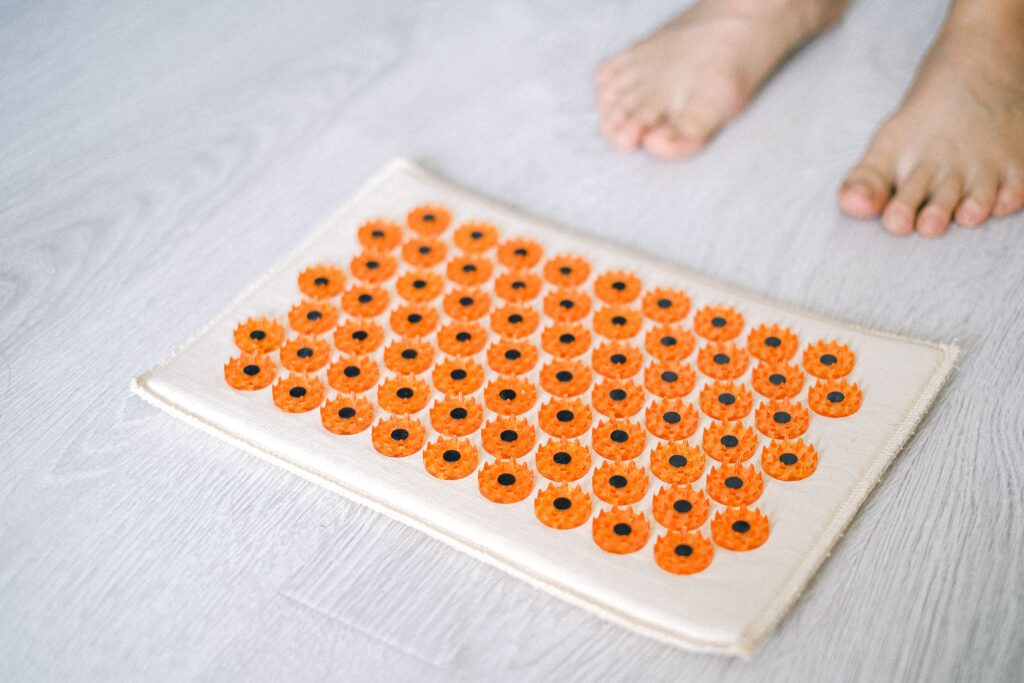
A mat is not that. A mat is several thousand undifferentiated plastic spikes pressing on whatever part of you happens to be lying on it. No point selection, no control of pressure, no practitioner. Borrowing the evidence from one and attaching it to the other is the single most common move in acupressure-mat marketing, and it does not hold up.
So the honest question is narrower: what has actually been measured on the mat itself?
What has actually been measured on the mat
Very little — but not nothing, and what exists is more interesting than either the sellers or the sceptics tend to admit.
The study worth knowing is Olsson and von Schéele (2011), published in the Journal of Alternative and Complementary Medicine, a randomised controlled trial with 32 healthy participants lying on a Shakti mat. What they recorded:
- Pain ratings rose immediately and peaked within 30 seconds, then subsided gradually — the authors describe this as habituation.
- While on the mat, systolic and diastolic blood pressure were higher, heart rate was slower, there was more high-frequency heart-rate variability, and there were signs of increased circulation in the back.
- Salivary cortisol did not differ.
Their conclusion, in their own careful words: healthy participants habituated to the induced pain and were able to subjectively relax; signs of both sympathetic and parasympathetic nervous system activity were present; and the pain “may hypothetically have triggered a parasympathetic response”.
Note that “hypothetically”. It is the authors’ word, not a hedge we added.
What that does — and does not — support
It supports: the sensation is real and it fades fast. The 30-second peak matches almost exactly what people describe the first time they lie down on one. And measurable autonomic changes did occur while participants were on the mat, which is more than can be said for a lot of wellness products.
It does not support: anything about treating a condition. Thirty-two healthy people, one session, measuring what happens while lying on the mat. The handful of later patient trials are small and had no sham control — we go through them in the objections section below.
And one finding deserves singling out, because it is the claim you will see most often on packaging: if a mat is sold to you as lowering your stress hormone, the one trial that measured cortisol found no change.
Side effects, and who should ask a doctor first
This is the part most pages skip entirely. The commonly reported effects are minor and mechanical:
- Redness and visible spike marks on the skin, which typically fade within an hour. Expected, not a warning sign.
- Sharp discomfort for the first half-minute. This is the thing the study measured directly.
- Light-headedness on standing up after lying still for a while. Get up slowly rather than briskly.
There are situations where this is a question for a doctor rather than a website — not because there is evidence of harm, but because there is no good evidence either way and “probably fine” is not good enough:
- Reduced skin sensation, for example from diabetic neuropathy. You cannot notice damage you cannot feel.
- Broken or irritated skin, or a skin condition where the mat would sit.
- A bleeding or clotting disorder, or blood-thinning medication.
- Pregnancy.
What it is reasonable to expect
Treat it as a relaxation tool with an unusually strong sensory hook, not as a treatment. If the thing you struggle with is switching off, then lying still for fifteen minutes with a sensation intense enough that you cannot think about your inbox is a mechanism that plausibly helps — and it is cheap enough to find out.
If what you actually have is chronic back pain that is not improving, a mat is not the answer to that question, and a doctor is.
How to try one without hating it
- Wear a thin t-shirt the first few times rather than going bare-skinned. It is genuinely sharp otherwise.
- Start with 5 to 10 minutes, lying on your back or with the mat against your lower back in a chair.
- Expect the worst of it in the first 30 seconds and decide after that, not during.
- Most people find it more comfortable, not less, by the third or fourth session.
If you want to see what a typical mat and pillow set actually includes, we describe one in detail on our ProsourceFit acupressure mat page.
Isn’t this just placebo? One 32-person session proves nothing
Fair objection, and the 2011 study cannot answer it: there was no sham mat, and the measurements were taken while people were lying on the spikes, not afterwards.
The better test came in 2023. Kisker and Schöne (Applied Psychology: Health and Well-Being) had healthy young adults practise relaxation for three weeks, 15 minutes a day, either on an acupressure mat or with no tool at all. Both groups reported less stress, better sleep and better well-being. The mat group did no better than the plain-relaxation group, and blood pressure, heart rate and pain thresholds did not change in either. The authors’ conclusion: taking time to relax helps a little, whichever method you use.
In pain patients the picture is slightly different but still thin. Two German pilot trials (Hohmann et al., 2012) randomised 40 people with chronic neck pain and 42 with chronic low back pain to two weeks of daily use of a spiked pad or a waiting list. Pain scores fell by roughly 30–36% in the pad groups, significantly more than in the controls. The catch is the comparison: a waiting list is not a placebo, and the authors say plainly that no valid sham for a spiked mat exists. An Italian trial (Frizziero et al., 2021) added a mat to an exercise programme for low back pain; pain and disability improved in both groups, with no significant difference between them.
So, honestly: against doing nothing, the mat has won. Against a proper control, it has not yet beaten simply lying down and relaxing. That is the evidence as it stands, not a verdict on what you will feel.
You say “ask a doctor” — but is there any actual safety evidence?
Very little, and it is worth being precise about why.
Across the published trials — roughly 32 healthy adults in 2011, 82 pain patients in 2012, 44 in 2021 and the 2023 student sample — the only adverse effect reported was discomfort in the first minutes of the first sessions. Nobody stopped because of it. That is reassuring for the people who were in those studies.
The problem is who was kept out. The patient trials excluded, among others:
- people on anticoagulants or with a known tendency to bleed;
- pregnant women;
- people with insulin-dependent or uncontrolled diabetes;
- skin disease, lesions or sunburn where the mat would sit;
- recent spine surgery, radiating nerve pain, or pain-altering conditions.
So the “no adverse effects” finding tells you nothing about those groups, because they were never tested. No trial has measured what a mat does to someone on blood thinners, or during pregnancy, or with diabetic neuropathy.
The manufacturers say much the same. Shakti Mat’s own usage rules state it cannot recommend the mat for people taking anticoagulants or with clotting disorders, for pregnant women, for people with heart problems, epilepsy or phlebitis, and advise against use on inflamed, wounded or sunburnt skin, with a doctor’s check for high blood pressure. Their stated reasons are precautionary, not trial-based.
If you are in any of those groups, the honest answer is not “it is probably fine” but “nobody has checked” — which is exactly when a clinician, not a website, should decide.
How long, how often, and in which position? Is any of that evidence-based?
Partly. There is no dose-finding study, so nobody knows the optimal duration. The authors of the 2012 pain trials wrote that “no data are available” on which duration and frequency work best, and doubted an exact dose-effect relationship exists. What we do have is the protocols the trials actually used:
- 2011 (healthy adults): a single session lying on the back, measuring responses in the first minutes; pain peaked within 30 seconds.
- 2012 (neck and back pain): about 30 minutes once a day for 14 days, lying with the bare painful area on the pad, preceded by 10 minutes with the hands (neck) or feet (back) on it. Patients were warned the first 2–5 minutes could hurt.
- 2021 (low back pain): 60 minutes a day for four weeks, on the back, starting with a shirt on.
- 2023 (healthy students): 15 minutes a day for three weeks, bare back.
- Manufacturer guidance (Shakti Mat): around 20 minutes a day to begin with.
Two things follow. First, every published protocol used the mat under the back or neck, lying down; the feet-and-hands step in the 2012 trials came from clinical habit, not evidence, and no trial has tested standing on a mat, sitting on it, or any “position for X” chart you may see online. Second, 15 minutes daily is the lowest dose at which anyone measured anything, and it produced no advantage over plain relaxation. If you want to copy the only protocols that reported pain reduction, that means daily use for at least two weeks, at 30 to 60 minutes, which is a bigger commitment than the packaging suggests.
Our earlier suggestion of 5 to 10 minutes is a comfort ramp, not a therapeutic dose. Build up from it, and stop if the skin does not recover between sessions.
Sources
- Olsson E, von Schéele B. J Altern Complement Med 2011 (PMID 21208128).
- Hohmann C et al. Evid Based Complement Alternat Med 2012 (PMID 22997531).
- Frizziero A et al. Applied Sciences 2021;11(11):5211.
- Kisker J, Schöne B. Appl Psychol Health Well Being 2023 (PMID 37715543).
- Shakti Mat, “Are acupressure mats dangerous? 10 rules for use” (manufacturer guidance). All checked 6 October 2026.
Common questions
Do acupressure mats actually work?
For relaxation, there is limited but real evidence that something physiological happens while you are on one — slower heart rate, higher heart-rate variability, increased circulation in the back. Against a waiting list, small pain-patient trials showed less pain; against simply relaxing without a mat, the one trial that tested it found no extra benefit. For treating a diagnosed condition, the evidence is thin and has no sham control.
Are acupressure mats scientifically proven?
No. One randomised trial of 32 healthy people in a single session, two small waiting-list pilot trials in pain patients and one three-week trial that found no advantage over plain relaxation are a starting point, not proof. The larger evidence base people cite is for manual acupressure on specific points, which is a different intervention.
Are acupressure mats safe?
In the published trials the only reported effect was initial discomfort, but those trials excluded people on blood thinners, pregnant women, uncontrolled diabetes and skin conditions. No study has tested those groups, and manufacturers advise against use in them. Ask a clinician first.
Do they lower cortisol or stress hormones?
The one study that measured salivary cortisol found no difference. Treat that claim as unsupported.
Why does it hurt at first and then stop?
Habituation. In the trial, pain ratings peaked within 30 seconds and then declined steadily while participants stayed on the mat.
Are there side effects?
Skin redness and spike marks that fade, initial discomfort, and occasional light-headedness on standing. See the section above for the situations where you should ask a doctor first.
How long should you lie on one?
No study has found an optimal dose. Trials used 15 minutes daily (healthy adults), 30 minutes daily for two weeks and 60 minutes daily for four weeks (pain patients). Start at 5 to 10 minutes for comfort and build up; stop if the skin does not recover between sessions. Anyone quoting you an exact number is guessing.
This page describes published research and commonly reported experiences. We have not run a trial ourselves, and nothing here is medical advice. Pages on this site may contain affiliate links; as an Amazon Associate we earn from qualifying purchases at no extra cost to you.