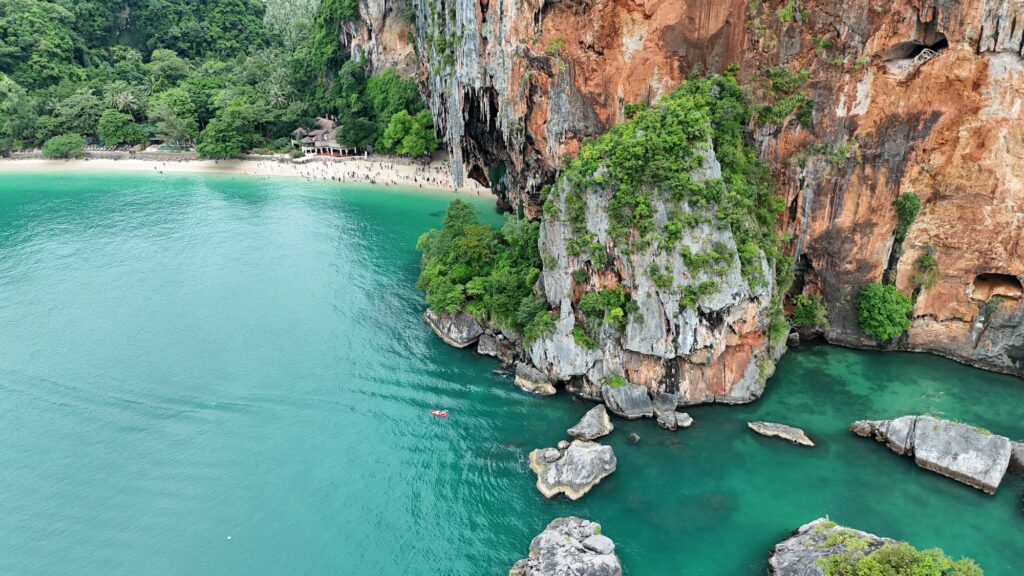
Krabi and the Andaman coast around Railay Beach and Koh Lanta pack an unusual amount of variety into a small stretch of Thailand: limestone karst cliffs that draw climbers from around the world, calm mangrove channels for kayaking, and warm, current-light water that makes swimming approachable for most fitness levels.
Kayaking through the karsts and mangroves
The mangrove channels around Ao Thalane and the lagoons near Railay are typically paddled by kayak on a rising tide, weaving between limestone towers that rise straight out of the water – a slow, low-impact way to cover a lot of ground without much technical skill required. Railay itself is one of the more accessible rock-climbing spots in the world for beginners, with guided half-day sessions on routes bolted directly into the limestone cliffs above the beach.
You can rent a kayak in Krabi, but the mangrove channels are easy to get lost in. A guided mangrove and canyon kayak tour takes about four hours and times the route with the tide.
Why core strength matters more than people expect
Both kayaking and climbing lean heavily on core stability rather than arm strength alone – a kayak stroke that comes from the torso is far more efficient than one that comes from the shoulders, and the same is true for keeping body tension on a climbing route. A few weeks of ab roller work before a trip like this pays off directly on the water and the wall, not just in how it looks.

A simple, compact core trainer that builds the rotational and anti-extension strength that carries directly into paddling and climbing.
See Full Review →Practical notes
- Dry season (November to April) has calmer seas and better visibility for kayaking; the monsoon months bring stronger currents and choppier water.
- Railay Beach is only reachable by boat – there is no road access, which keeps it noticeably quieter than the mainland beaches nearby.
- Climbing shoes and harnesses are provided by guide operators for beginner sessions – no need to travel with gear.
Where to stay
Ao Nang on the mainland is where most kayak and climbing pickups start; Railay is quieter but boat-only, so luggage goes on a longtail. We have not stayed at a specific hotel there; compare options for your dates: stays in Ao Nang on Booking.com or on Railay (affiliate links).
Know before you go
Checked against official sources in October 2026. Rules and fees change, so confirm with the source before you travel.
- Digital arrival card: All foreign nationals entering Thailand by air, land or sea must complete the Thailand Digital Arrival Card online, within 3 days before arrival. (UK FCDO travel advice)
- Length of stay: From 15 September 2026, visitors entering under the visa exemption scheme, which covers British passport holders, can stay up to 30 days for tourism. You may be asked to show at least 10,000 baht per person and proof of onward travel. Other nationalities should check their own rules. (UK FCDO travel advice)
- Sunscreen in marine parks: Thailand bans sunscreen containing oxybenzone, octinoxate, 4-methylbenzylidene camphor or butylparaben in its marine national parks, with fines of up to 100,000 baht. Visitors are asked to stay at least 2 metres from coral and not to touch or stand on it. (Thai Department of National Parks, in Thai)
- Beach flags: Thailand has lifeguards at designated beaches and uses a flag system for safe swimming. Follow warning signs, especially red flags; people have drowned in strong riptides. (UK FCDO travel advice)
- Jellyfish: Jellyfish can come close to shore, especially in the rainy season from May to October, and their stings can be fatal. (UK FCDO travel advice)
- Vapes are illegal: It is illegal to possess or use any vape, e-cigarette, pod, e-liquid or heat-not-burn device in Thailand. Fines are typically 5,000 to 30,000 baht. (UK FCDO travel advice)
- Health: The UK’s travel health service lists a dengue risk in Thailand and says rabies has been reported in domestic animals. Avoid mosquito bites, especially during the day. (TravelHealthPro (NaTHNaC))
Pack for it
The gear that earns its space on this particular trip. Each review states what the item does well and one honest downside, with current pricing on Amazon.
- Liquid I.V. Hydration Multiplier – Kayaking through the karsts in tropical humidity is a full sweat day, even sitting down.
- Rainleaf microfiber travel towel – Everything is wet on a kayaking day; this one is dry again by evening.
- LifeStraw Go filter bottle – Refill for a day on the water rather than carrying bottles into a mangrove.
As an Amazon Associate I earn from qualifying purchases. This is a researched recommendation, not a claim of personal testing, and none of this is medical advice.
Some links on this page are affiliate links: product links go to our own review pages, and tour links go to Viator or GetYourGuide, and hotel links go to Booking.com (via CJ). If you book or buy through them we may earn a commission, at no extra cost to you. We have not taken these tours ourselves; we picked them because they match the activity described.