Costa Rica built its tourism brand on the word “pura vida,” but for active travelers the real draw is density: cloud-forest hikes, rainforest zip-lines, and Pacific beach breaks are often within an hour of each other. Unlike destinations where you pick one activity type and stick to it, a single week here can mix a real trek, a paddle through mangroves, and a flat beach run without much logistics.
Rainforest trails and mangrove paddling
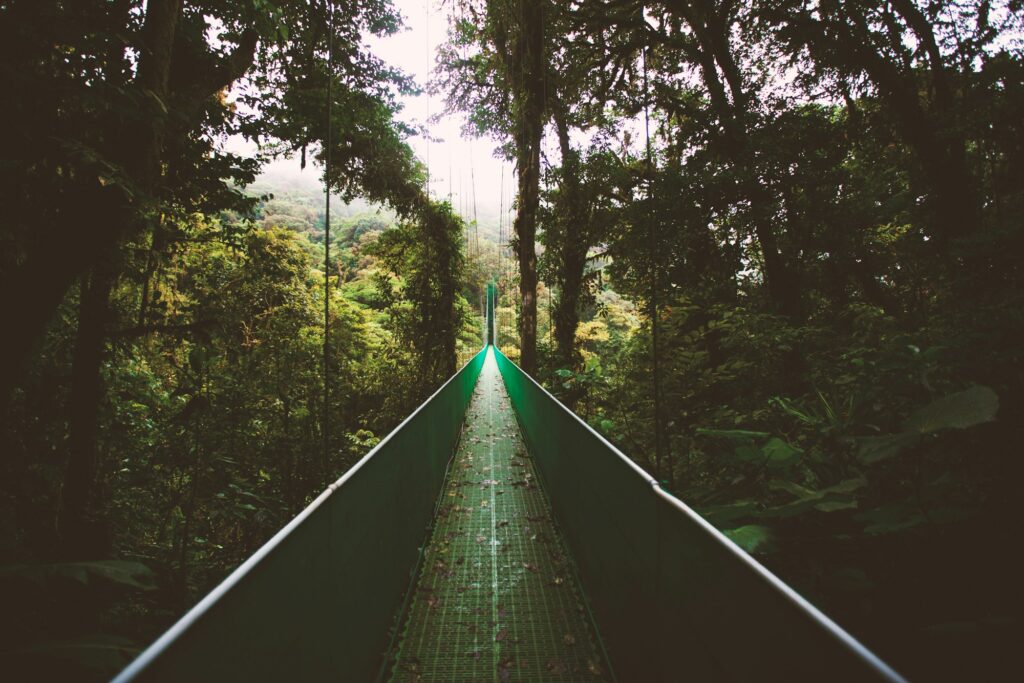
Monteverde and Manuel Antonio are the two most-visited hiking areas, and both have marked trail networks suitable for a range of fitness levels — Manuel Antonio’s coastal trails are flatter and shorter, while Monteverde’s cloud-forest paths involve more sustained elevation change and mud after rain. On the Pacific side, the mangrove estuaries near the Nicoya Peninsula and Damas Island are paddled by kayak or SUP, a slower, quieter way to see the wildlife that the zip-line tours fly straight past.
Mangrove paddling is best done with someone who knows the tides and where the wildlife is. A guided mangrove kayak tour near Manuel Antonio takes about three hours with a naturalist guide.
Why rucking beats a normal daypack here
Cloud-forest trails climb more than they look like they will on a map, and carrying real trail weight — water, layers for the temperature swing between forest floor and canopy, a change of clothes for the humidity — turns an ordinary hike into a proper strength session if you load it deliberately. Training with a weighted vest before the trip, even just on flat local walks, makes the actual trail day noticeably easier on the legs and lower back.

Adjustable weighted vest for rucking and hiking prep, built to sit close to the body without bouncing on uneven terrain.
See Full Review →Practical notes
- Dry season (Dec–Apr) has the most reliable hiking weather; green season (May–Nov) means afternoon rain but far fewer crowds.
- Manuel Antonio and Monteverde are on opposite sides of the country — most itineraries pick one, not both, unless the trip is two weeks or longer.
- Reef shoes or closed-toe water sandals are worth packing for mangrove kayaking; sharp oyster shells and mangrove roots are common near the banks.
Where to stay
Manuel Antonio and Monteverde are a long drive apart, so base yourself near the one you chose: Quepos and Manuel Antonio for the mangroves and the national park, Santa Elena for the Monteverde cloud forest. We have not stayed at a specific hotel there; compare options for your dates: stays in Manuel Antonio on Booking.com or in Monteverde (affiliate links).
Know before you go
Checked against official sources in October 2026. Rules and fees change, so confirm with the source before you travel.
- Monteverde hours and access: The Monteverde Cloud Forest Preserve is open 7:30 a.m. to 4:00 p.m. You park for free at the Visitor Center, 1.5 km below the entrance, and a free shuttle takes you to the trailhead. (Monteverde Cloud Forest Preserve)
- Book a time slot: Entry runs on booked time slots. Shuttles leave on time and late arrivals may not be let in. You get a full refund if you cancel at least 48 hours ahead. (Monteverde Cloud Forest Preserve)
- Monteverde trail lengths: There are three self-guided circuits: 1.4 km (about 1 hour), 2.8 km (about 1.5 hours) and the Continental Divide Trail at 4.1 km (about 2.5 hours, moderate). (Monteverde Cloud Forest Preserve)
- Manuel Antonio tickets: The park is open Wednesday to Monday, 7:00 a.m. to 3:00 p.m., and closed on Tuesdays. Tickets are sold online only through SINAC. Foreign adults pay US$16 plus VAT, and you must show ID at the gate. (SINAC)
- Manuel Antonio rules: You may not bring food or drinks into the park, apart from exceptions set by the park administration. The park has no visitor parking. (SINAC)
- Rip currents: Rip currents are very common on Costa Rican beaches and many have no lifeguards. Drownings average 50 to 60 a year, and about a third of the victims are tourists. (UK FCDO)
- Mosquitoes: The CDC has issued a Level 2 notice for a chikungunya outbreak in northwest Costa Rica, and dengue is also present. It advises covering skin and using a repellent such as DEET or picaridin. (CDC)
Pack for it
The gear that earns its space on this particular trip. Each review states what the item does well and one honest downside, with current pricing on Amazon.
- LifeStraw Go filter bottle – Refill from streams on rainforest trails instead of carrying a day of bottled water uphill.
- Rainleaf microfiber travel towel – Nothing air-dries in rainforest humidity; a microfiber towel at least dries faster than cotton.
- Liquid I.V. Hydration Multiplier – Paddling and trail days in that heat are exactly the sweat load electrolytes are for.
As an Amazon Associate I earn from qualifying purchases. This is a researched recommendation, not a claim of personal testing, and none of this is medical advice.
Some links on this page are affiliate links: product links go to our own review pages, and tour links go to Viator or GetYourGuide, and hotel links go to Booking.com (via CJ). If you book or buy through them we may earn a commission, at no extra cost to you. We have not taken these tours ourselves; we picked them because they match the activity described.