Researched guide — we have not visited or booked this ourselves. Built from the Turkish Ministry of Culture and Tourism, UNESCO and the official Go Türkiye portal. Part of our rulebooks. This page contains affiliate links (see the note at the end).
Most people arrive at Pamukkale expecting to walk across the whole white hillside from the photos. Then they find that most of the terraces are roped off, that shoes come off before the white path starts, that the famous Antique Pool is a separate ticket, and that the ticket office shuts an hour before the site does. None of that is hidden, but it is spread across a ministry page, a UNESCO file and a tourism portal. This page puts the rules for Pamukkale and Hierapolis in one place, quoting each official source and saying where the sources disagree.
The short answer
One ticket of €30 for foreign visitors covers the Hierapolis ancient city and the travertines. The site is open every day; the ministry lists 08:00 to 18:00, with the box office closing at 17:00. You walk the travertines barefoot, on the marked route only, because most terraces are closed to protect the water flow. Swimming in the Antique Pool (often sold as Cleopatra’s Pool) is extra. Bring a bag for your shoes, sun protection and a towel if you plan to swim.
Pamukkale rules at a glance
| Rule | What the official source says | Source |
|---|---|---|
| Ticket | €30, one ticket for the Hierapolis archaeological site and the Pamukkale travertines; the Müzekart museum pass applies to Turkish citizens | Ministry of Culture and Tourism |
| Opening hours | Open every day, 08:00 to 18:00; box office closes 17:00 | Ministry |
| Gates | South Gate and North Gate close at 18:00; the pedestrian entrance closes at 17:00 | Ministry (Turkish page) |
| Shoes | The terrace walk is done barefoot, wading through shallow warm water | Go Türkiye |
| Where you may walk | Visitor access to the travertine terraces is prohibited to keep the water flowing and the white colour intact; visitor routes and information panels are provided | UNESCO |
| Bathing | Designated bathing areas have been set up; the Antique Pool is listed as open | UNESCO, Ministry |
| Cars | Private vehicles may not enter the site except in emergencies; public transport is provided | UNESCO |
| Audio guide | An audio guide service is available | Ministry |
Do you really have to go barefoot?
Yes, on the white travertine path. Turkey’s official tourism portal describes the terrace walk as a barefoot stroll “without shoes”, wading in warm water up to your knees over soft calcite deposits (Go Türkiye). The reason is the rock itself. The same portal explains that the terraces only keep forming while mineral-rich water keeps flowing over them, and that preserving the natural direction of that flow is essential. Shoes scuff and dirty a surface that is still being built.
One honest caveat: we could not find the shoe rule written out as a formal regulation on an official page we could open. What is official is the barefoot walk described by Go Türkiye and the UNESCO note that the terraces themselves are closed to visitors. In practice that means you carry your shoes through the travertine section and put them back on when you reach Hierapolis. A small bag or tote for the shoes makes this much easier, and it frees your hands on wet, uneven ground.
Why most of the white terraces are roped off
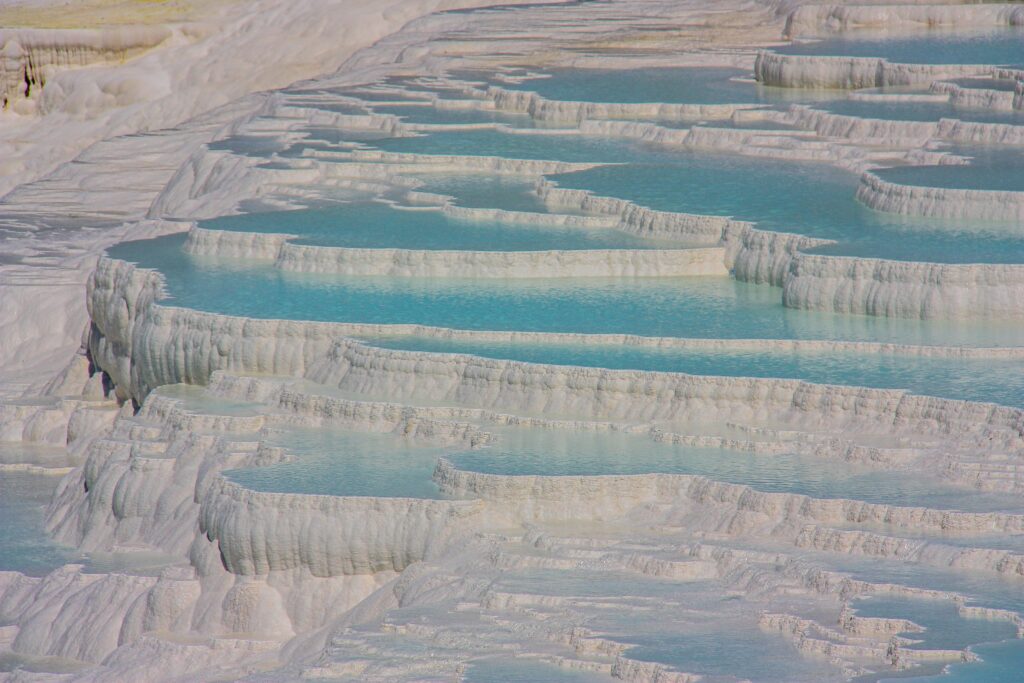
The terraces you see in drone photos are mostly off limits. UNESCO’s file for the site states that “visitor access to the travertine terraces is prohibited in order to sustain the water flow and to maintain the colour and structure of the travertine terraces”, and that bathing areas were created instead (UNESCO). The same file lists the earlier fixes: hotels on the site and structures around the thermal pool were removed, and the road through the south-eastern terraces was closed.
This is what separates Pamukkale from a lido. The formations are a living deposit. Go Türkiye puts the water that keeps today’s terraces forming at 35 to 36°C (source), and UNESCO describes terraces from under a metre to as much as six metres high, fed by springs in a cliff almost 200 metres above the plain. Stay on the marked route and inside the pools where wading is allowed, and you are doing what the site’s managers ask.
Tickets and opening hours
The ministry’s English page for the site shows a single price of €30 and the status “Open” (source). That ticket covers both the ancient city of Hierapolis and the travertines, which sit side by side and were inscribed together on the World Heritage List in 1988 (UNESCO). The ministry’s Müzekart pass is listed as valid for Turkish citizens; it says nothing about foreign visitors using it here, so plan on the €30 ticket.
On hours, the live ministry page gives 08:00 to 18:00 every day, with the box office closing at 17:00. Its Turkish version adds that the South and North Gates close at 18:00 and the pedestrian entrance at 17:00. The ministry’s downloadable brochure prints a longer, seasonal table instead, with the South Gate opening at 6:30 and closing between 18:00 and 21:00 depending on the month (brochure PDF). The brochure is undated, so we treat the live page as current. Either way, the safe plan is to be inside before 17:00.
The Antique Pool (Cleopatra’s Pool)
The Antique Pool is inside Hierapolis, it is a separate paid swim, and it is not the same as wading on the terraces. Go Türkiye says it was formed after an earthquake in 692 AD, holds a constant 36°C and lets you swim among submerged ancient columns; the Cleopatra name comes from a local legend (source). The ministry page currently lists the pool as open to visitors.
The ministry does not publish the pool’s own entry price, and the figures on travel blogs vary, so we do not repeat one. Check the price at the pool desk on the day. Both tour listings below treat the swim as an extra on top of the tour. Bring swimwear and a towel if you want to go in. UNESCO also notes that heavy use of the pool area causes biological pollution and erosion of the ancient marble, which is a good reason to follow whatever rules the pool posts on the day.
Sun, glare and wet feet
Pamukkale is a white, reflective hillside with almost no shade, and you are barefoot in water. The NHS points out that water reflects UV rays and increases your exposure, that the cooling water can make you think you are not burning, and that reflected sunlight from bright surfaces is particularly hard on the eyes (NHS). Its advice fits the site well: at least SPF 30, reapplied straight after you have been in water, sunglasses, a hat, and shade during the hottest hours. The tops of your feet are easy to forget.
The surface is the other thing to plan for. Go Türkiye calls the calcite soft underfoot, but the travertine is uneven and wet, so walk slowly and keep your phone in a pocket or bag rather than in your hand. If you are travelling in summer, our travel health page collects the other practical heat and travel advice we have checked.
Going on a day tour instead
Many travellers reach Pamukkale on a long day trip from the coast. Two listings match this page exactly: the Pamukkale, Hierapolis and Cleopatra’s Pool tour from Antalya on Viator and the Antalya Pamukkale, Hierapolis and Cleopatra’s Pool tour on GetYourGuide. Both are about 12 hours with hotel pickup and lunch, and both list free cancellation up to 24 hours before. The Viator listing includes the site entry tickets; the GetYourGuide listing includes them only if you pick that option. On both, the pool swim costs extra, and both itineraries include a shopping stop, which some reviewers say cuts into time at the site. Read what each includes on the day you book.
Pamukkale is Turkey’s outdoor bathing tradition. For the indoor one, our Turkish bath etiquette for Istanbul sets five historic hammams side by side, and traditional vs spa hammam in Marrakech does the same across the Mediterranean.
FAQ
Can you wear shoes at Pamukkale?
Not on the white travertine path. Turkey’s official tourism portal describes the terrace walk as barefoot, through shallow warm water. Carry your shoes in a bag and put them on again in Hierapolis.
How much is the Pamukkale entrance fee?
The Ministry of Culture and Tourism lists €30, one ticket for Hierapolis and the travertines. Swimming in the Antique Pool is paid separately.
Can you swim in the Pamukkale terraces?
You can wade in the pools along the marked route, but most terraces are closed to visitors, according to UNESCO. For a real swim, use the Antique Pool inside Hierapolis, which has its own fee.
What time does Pamukkale close?
The ministry lists 18:00, with the box office and the pedestrian entrance closing at 17:00. Its older brochure shows longer seasonal hours, so arrive before 17:00 to be safe.
Sources and verification
- Republic of Türkiye Ministry of Culture and Tourism: Hierapolis Pamukkale Travertine Archaeological Site, site brochure (PDF)
- UNESCO World Heritage Centre: Hierapolis-Pamukkale (property 485)
- Go Türkiye (Türkiye Tourism Promotion and Development Agency): Pamukkale Travertines: Formation, Characteristics & Activities
- NHS: Sunscreen and sun safety
- Tour listings: Viator product 63871P3, GetYourGuide product 452275
Last verified: October 2026. Prices, hours and rules change, and the site’s own current page and staff on the day take precedence over this page. We have not visited Pamukkale or booked these tours. This page is not medical advice.
This page contains affiliate links (Viator, GetYourGuide). If you book through them we earn a commission at no extra cost to you. We chose these listings because they cover the exact sites described on this page. This is not medical advice. Full disclosure.