A researched guide, not a personal test report. Sources are listed at the bottom; product notes link to our full shelf reviews.
Most advice about sleeping on a long-haul flight is either a shopping list or a pep talk. Neither helps much at 2 a.m. body time, upright in a cold cabin with the cabin lights on. What actually decides whether you land rested is simpler and less glamorous: when you try to sleep, what you drink before you try, and whether you have dealt with the three things that keep waking you up — light, noise and your head dropping forward.
Here is that in the order it matters, with the one honest caveat first: no pillow, mask or plug fixes jet lag. They help you sleep when you choose to. The choosing is the part that does the work.
Step 1: Decide when to sleep before you board
Jet lag is your internal clock running on departure time while the world around you runs on arrival time. The CDC Yellow Book, the reference US travel clinicians use, treats it as a real disorder once you cross at least two time zones — and notes that flying east is harder than flying west, because it asks your body to go to sleep earlier than it wants to.
So the first question is not “how do I sleep on the plane” but “should I sleep on the plane, and when”. A workable rule:
- Overnight flight arriving in the morning: sleep as early in the flight as you can, and as much as you can. You want to land able to stay up until a normal local bedtime.
- Daytime flight arriving in the evening: stay mostly awake, nap briefly if you must, and go to bed soon after you arrive.
- Anything in between: set your watch to destination time when you board and sleep when it is night there.
That decision is free, and it is worth more than everything in the rest of this article.
Step 2: Skip the two drinks that feel like they help
The free wine and the post-dinner coffee are the two most common ways people sabotage in-flight sleep. The Yellow Book is direct about alcohol: it helps you fall asleep faster but fragments the sleep you get, and both alcohol and caffeine add to the dehydration that makes jet lag feel worse. Caffeine has a half-life of roughly five hours, so a coffee with the meal service is still half in your system when you are trying to sleep.
Water, and plenty of it. Boring, and it works.
Step 3: Fix the three things that wake you up
Once you have picked your window, sleep on a plane mostly fails for three mechanical reasons. The Yellow Book itself suggests an eye mask and earplugs for the flight; the neck is the one it does not mention and the one that wakes most people.
Your head drops forward
This is the classic jolt awake. Upright sleep fails when your chin falls to your chest, not when your head tips sideways. That is why the common U-shaped pillow worn “the normal way” often disappoints: the thick part sits behind your neck, where you need the least support.
The fix that turns up again and again in buyer reviews is to turn the pillow around, so the thick part sits under your chin. It looks odd. It works better. Also useful: recline the seat, push your hips all the way back, and if you have a window seat, lean into the wall rather than the aisle.
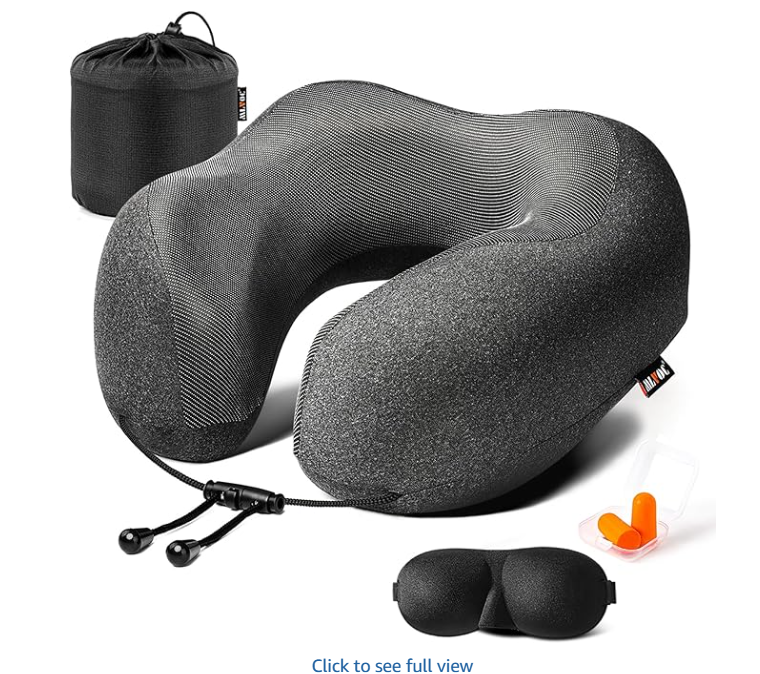
MLVOC Travel Neck Pillow 3-in-1 Kit
Memory-foam pillow with an adjustable drawstring, sold as a kit with a contoured eye mask and earplugs. The honest downside: it is bulky and hard to get back into its bag, and it suits average necks better than slim ones.
Read our full reviewThe light never quite goes off
Cabins dim, but reading lights, seatback screens and the galley stay on. Light hitting your eyes is one of the strongest signals your body uses to decide whether it is day, which is exactly why the Yellow Book builds its jet lag advice around timing light exposure. On the plane, the job is the opposite: block it completely while you sleep.
Flat masks press on the eyelids and leak at the nose. A contoured mask with deep eye cups solves the first; getting the strap below the crown of your head, not across it, solves most of the second.

MZOO 3D Contoured Sleep Mask
Deep moulded eye cups, so nothing touches your eyelids and you can blink. Works for side sleepers. The honest downside: some buyers report it slips off overnight if they move a lot.
Read our full reviewThe noise is constant, and then it isn’t
Engine drone is easy to sleep through. What wakes you is the change: a trolley, an announcement, a baby two rows back. Earplugs will not give you silence, and any product promising that is overselling. What they do is take the edges off sudden sounds so your own tiredness can do the rest.
Fit matters more than the brand. Try every tip size in the box, insert with a slight twist rather than a push, and do it before you are exhausted — fiddling with earplugs half-asleep is how you lose one under the seat.

Loop Quiet 2 Ear Plugs
Reusable soft silicone plugs rated at 24 dB SNR, with four tip sizes and a small case. The honest downside: effectiveness varies by ear shape, and 24 dB is not enough for some against heavy snoring.
Read our full reviewStep 4: Set up your seat before you need it
The ten minutes after the meal service are when most people are ready to sleep and least ready to prepare. Do it earlier, while you are still alert:
- Fasten your seatbelt over your blanket, so the crew does not need to wake you to check it.
- Put the mask, plugs and a water bottle in the seat pocket, not the overhead bin.
- Take off your shoes and wear socks; cold feet keep people awake more than they realise.
- Turn off the seatback screen rather than letting it time out — it will light up again at the next announcement.
- Layer up. Cabins swing between warm during boarding and cool at cruise.
Step 5: After you land, light does the rest
On arrival, daylight is the most effective tool you have. According to the Yellow Book, morning light helps shift your clock earlier, which is what you need after flying east, while evening light shifts it later, which helps after flying west. If you have just crossed a lot of time zones, the timing can be counterintuitive; the Yellow Book points travellers to jet lag calculators for a personal schedule. Where daylight is not available at the hour you need it — a winter arrival in Lapland, or a landing well before sunrise — a light therapy lamp is the artificial stand-in; light-therapy guidance generally points to 10,000 lux, far brighter than ordinary room lighting.
Melatonin and prescription sleep aids come up in every jet lag discussion. They are a conversation for your doctor, not for a travel blog — dosing and timing depend on the direction you fly and your own health.
Do you need to buy anything?
Honestly: not necessarily. Many airlines hand out a basic mask and foam plugs on long-haul flights, and a rolled-up jumper under the chin does part of what a pillow does. Buy gear if the free versions have failed you before. If you fly long-haul more than once or twice a year, the three items above cost less than one bad first day of a trip.
If your trip is a wellness trip in its own right, our destination guides cover Iceland, Finnish Lapland and Hokkaido — all long flights from most of the world, and all worth arriving rested for.
Frequently asked questions
Is it better to sleep or stay awake on a long-haul flight?
It depends on when you land. On an overnight flight arriving in the morning, sleep as much as you can. On a flight arriving in the evening, stay mostly awake so you can sleep at a normal local bedtime.
Which way should I wear a travel neck pillow?
If your head keeps dropping forward, try it backwards, with the thick part under your chin. That is the failure that wakes most people up, and the standard orientation does little to stop it.
Does alcohol help you sleep on a plane?
It helps you fall asleep faster but makes the sleep more fragmented, and it adds to dehydration. The CDC Yellow Book advises minimising it during flights.
Do earplugs block aircraft noise completely?
No. They reduce it, and they soften sudden sounds most. Low-frequency engine drone is the hardest noise to block, and it is also the easiest to sleep through.
Sources
- CDC Yellow Book — Jet Lag Disorder: time-zone threshold, east vs west, light timing, alcohol and caffeine, eye masks and earplugs.
- Product details: manufacturer specifications and recurring patterns in public buyer reviews, as summarised on each linked shelf page.
We have not personally tested the products mentioned here. Some pages on this site contain Amazon affiliate links, from which we earn a commission on qualifying purchases at no extra cost to you. This article is general information, not medical advice.